Full-Stack Web Development for Enterprise: The Complete 2026 Guide to Scalable Digital Solutions
Discover how enterprise-grade full-stack web development drives business growth, reduces operational costs, and gives large organizations a competitive edge in the digital landscape.
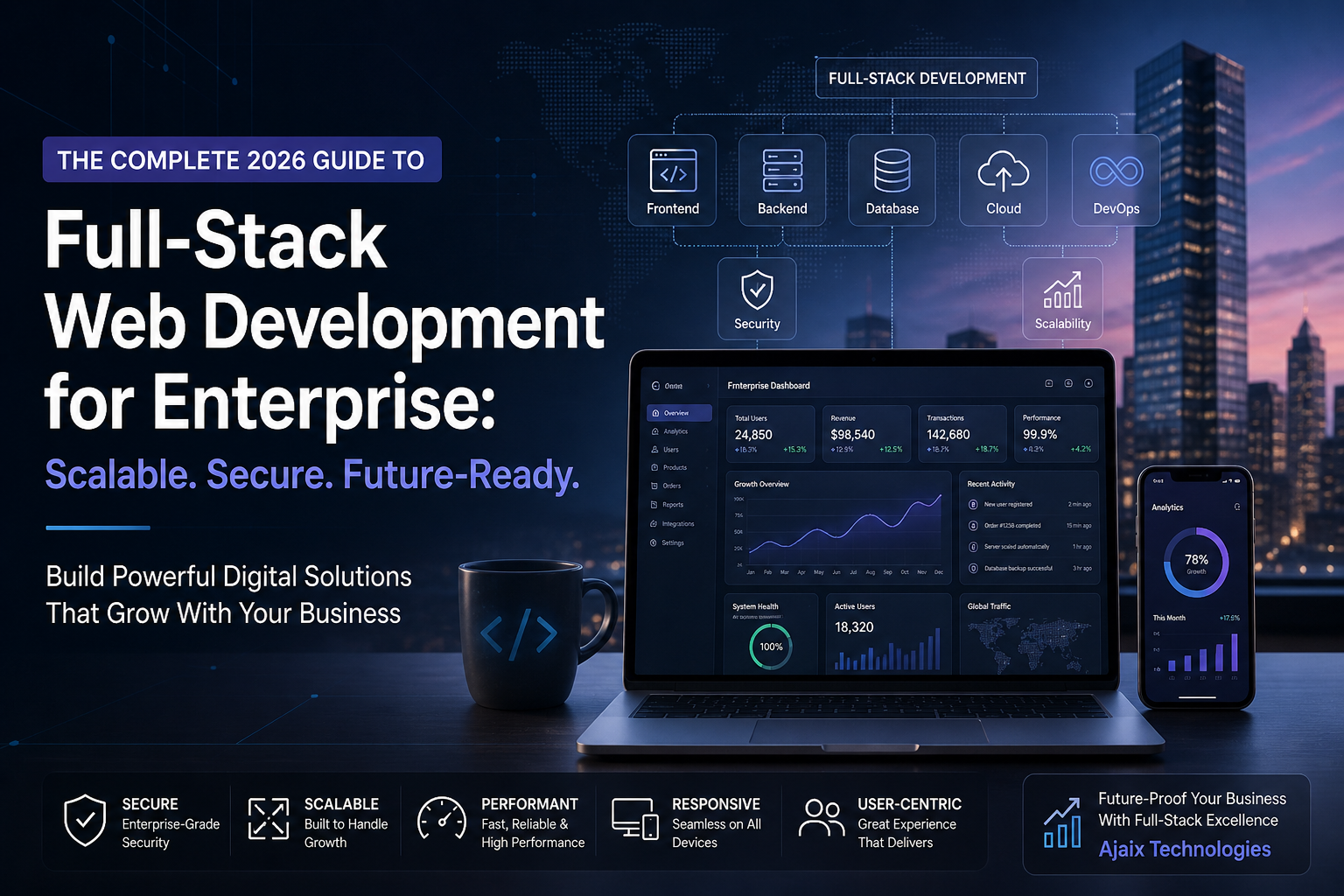
Full-Stack Web Development for Enterprise: The Complete 2026 Guide to Scalable Digital Solutions
Enterprise organizations today face a critical decision: rely on off-the-shelf software that constrains your growth, or invest in full-stack web development that’s engineered precisely for your operational scale, security requirements, and long-term vision.
The answer, for companies serious about digital transformation, is rarely the former.
In this guide, we break down everything enterprise decision-makers need to know about full-stack web development — from architecture choices and technology stacks to ROI benchmarks, vendor selection criteria, and what separates a truly scalable solution from one that buckles under enterprise load.
Table of Contents
- What Is Full-Stack Web Development?
- Why Enterprise Organizations Need Custom Full-Stack Solutions
- Core Components of an Enterprise Full-Stack Architecture
- Top Technology Stacks for Enterprise in 2026
- Key Challenges in Enterprise Web Development (and How to Solve Them)
- Security and Compliance: A Non-Negotiable Priority
- How to Evaluate a Full-Stack Development Partner
- ROI of Custom Full-Stack Development for Enterprise
- Case Study: What a Successful Enterprise Web Project Looks Like
- Next Steps: Starting Your Enterprise Web Development Journey
1. What Is Full-Stack Web Development?
Full-stack web development refers to the end-to-end design, development, and deployment of web applications — covering both the frontend (what users see and interact with) and the backend (servers, databases, APIs, and business logic).
A full-stack development team manages the entire product lifecycle:
- Frontend (Client-Side): User interfaces built with frameworks like React, Vue, or Angular — delivering fast, responsive, and accessible experiences across all devices.
- Backend (Server-Side): Application logic, APIs, authentication, and data processing using technologies like Node.js, Python (Django/FastAPI), Java (Spring Boot), or .NET.
- Database Layer: Structured or unstructured data storage using PostgreSQL, MySQL, MongoDB, Redis, or cloud-native solutions like AWS Aurora.
- DevOps & Infrastructure: CI/CD pipelines, containerization (Docker/Kubernetes), cloud deployments (AWS, Azure, GCP), and monitoring systems.
For enterprise organizations, this end-to-end ownership is not a luxury — it is the foundation of digital reliability.
2. Why Enterprise Organizations Need Custom Full-Stack Solutions
Off-the-shelf platforms work for simple use cases. But when your organization operates at enterprise scale — thousands of users, complex workflows, strict compliance requirements, and mission-critical uptime — generic software becomes a liability, not an asset.
Here is why leading enterprises are investing in custom full-stack development:
Built for Your Exact Workflows
Enterprise operations are rarely linear. Custom-built applications model your specific business processes — approvals, hierarchies, integrations, and edge cases — without workarounds or costly third-party plugins.
Seamless Integration with Legacy Systems
Most enterprise environments run a mix of legacy ERP systems, CRMs, and third-party data sources. A skilled full-stack team designs APIs and middleware that connect your existing infrastructure without a costly rip-and-replace.
Unlimited Scalability
SaaS platforms impose user limits, storage caps, and feature restrictions. Custom full-stack solutions scale horizontally — handling traffic spikes, geographic expansion, and growing data volumes without vendor-imposed ceilings.
Total Data Ownership and Sovereignty
Enterprise clients in regulated industries (finance, healthcare, legal) cannot afford data residency ambiguity. Custom applications give you complete control over where your data lives and how it is handled — a requirement, not a preference.
Competitive Differentiation
When your digital product is unique to your business, it cannot be replicated by competitors using the same SaaS tool. Custom technology becomes a moat.
3. Core Components of an Enterprise Full-Stack Architecture {#core-components}
A production-ready enterprise web application is composed of several tightly integrated layers. Understanding these helps enterprise stakeholders ask the right questions when evaluating development partners.
Frontend Layer
- Framework: React.js, Next.js, Angular, or Vue.js
- Design System: A custom, branded component library ensuring UI consistency at scale
- Performance Optimization: Code splitting, lazy loading, CDN delivery, and Core Web Vitals compliance
- Accessibility: WCAG 2.1 AA compliance for corporate digital inclusivity mandates
Backend & API Layer
- RESTful and GraphQL APIs for flexible data querying
- Microservices Architecture for modular, independently deployable services
- Message Queues (RabbitMQ, Apache Kafka) for asynchronous, high-throughput operations
- Authentication & Authorization: OAuth 2.0, SAML, LDAP, and SSO integration for enterprise identity providers
Data Layer
- Relational Databases: PostgreSQL or MySQL for transactional integrity
- NoSQL Databases: MongoDB or DynamoDB for flexible, document-based storage
- Caching: Redis for high-speed data retrieval and session management
- Data Warehousing: Integration with Snowflake, BigQuery, or Redshift for analytics
Infrastructure & DevOps
- Cloud Platforms: AWS, Microsoft Azure, or Google Cloud Platform
- Containerization: Docker and Kubernetes for portable, scalable deployments
- CI/CD Pipelines: Automated testing, staging, and deployment workflows
- Observability: Centralized logging, real-time monitoring, and alerting (Datadog, Grafana, New Relic)
4. Top Technology Stacks for Enterprise in 2026
Choosing the right technology stack is a strategic decision. Here are the most proven combinations for enterprise-grade full-stack projects:
| Stack | Best For | Key Strengths |
|---|---|---|
| Next.js + Node.js + PostgreSQL | SaaS platforms, portals | Performance, SEO, rapid development |
| React + Java Spring Boot + MySQL | Large-scale enterprise apps | Stability, mature ecosystem, compliance |
| Angular + .NET Core + SQL Server | Microsoft-integrated environments | Enterprise support, security, tooling |
| Vue.js + Python FastAPI + MongoDB | Data-heavy dashboards | Speed, flexibility, analytics-ready |
| React Native + Node.js + AWS | Cross-platform mobile + web | Unified codebase, cloud-native scalability |
The right choice depends on your existing infrastructure, team familiarity, compliance obligations, and long-term scalability requirements — all factors a seasoned full-stack partner will assess before recommending a direction.
5. Key Challenges in Enterprise Web Development (and How to Solve Them) {#key-challenges}
Enterprise projects come with complexities that mid-market and startup-focused development agencies are simply not equipped to handle. Here are the most common challenges — and how they are addressed by an experienced full-stack team.
Challenge 1: Managing Complex Stakeholder Requirements
Enterprise projects involve product owners, IT security, legal, compliance, and C-suite stakeholders — each with different priorities.
Solution: Structured discovery workshops, detailed technical specifications, and agile sprint cycles with regular stakeholder reviews. Clear documentation prevents scope creep and misalignment.
Challenge 2: Maintaining Performance at Scale
A web application that performs beautifully for 100 users may degrade under 10,000 concurrent sessions.
Solution: Load testing from day one, horizontal auto-scaling on cloud infrastructure, database query optimization, and caching strategies baked into the architecture — not bolted on later.
Challenge 3: Integration with Existing Enterprise Systems
Connecting a new web application to SAP, Salesforce, Oracle, or proprietary legacy systems requires deep API knowledge and middleware expertise.
Solution: Dedicated integration layers, event-driven architecture, and robust error handling to ensure data flows reliably between systems without data loss or latency.
Challenge 4: Long-Term Maintainability
Enterprise applications are not temporary projects — they run for decades. Code quality and documentation often suffer when speed is prioritized over sustainability.
Solution: Enforced coding standards, comprehensive test coverage (unit, integration, end-to-end), thorough technical documentation, and knowledge transfer protocols that protect your investment long after launch.
6. Security and Compliance: A Non-Negotiable Priority
Enterprise clients operate in regulated environments where security is not a feature — it is a baseline requirement. Full-stack development at the enterprise level must be built with security-first principles embedded throughout the software development lifecycle (SDLC).
What Enterprise-Grade Security Looks Like
- OWASP Top 10 Mitigation built into the development process
- End-to-end encryption for data in transit (TLS 1.3) and at rest (AES-256)
- Role-Based Access Control (RBAC) with principle of least privilege
- Regular penetration testing and automated vulnerability scanning
- Audit logging for complete traceability of user actions
- GDPR, HIPAA, SOC 2, and ISO 27001 compliance support depending on your industry
Identity and Access Management
Enterprise environments typically require integration with existing identity providers — Microsoft Active Directory, Okta, or Google Workspace. Single Sign-On (SSO), multi-factor authentication (MFA), and session management must all be handled correctly to protect sensitive systems and user data.
7. How to Evaluate a Full-Stack Development Partner
Selecting a development partner for an enterprise project is one of the most consequential decisions your technology leadership will make. Beyond portfolio and pricing, here are the criteria that matter most:
Technical Depth
Does the team have genuine full-stack expertise — or do they specialize in one layer and subcontract the rest? Request detailed architecture discussions, not just case study PDFs.
Enterprise Experience
Enterprise projects differ fundamentally from startup work. Look for experience with compliance requirements, legacy integrations, multi-stakeholder projects, and large-scale deployments.
Communication and Project Governance
How does the team communicate? What does their project management process look like? Enterprise projects require clear escalation paths, regular reporting, and transparent timelines.
Post-Launch Support
A web application is not finished at launch — it evolves. Evaluate support retainers, SLA commitments, incident response times, and the team’s ability to provide ongoing development as your needs change.
Security Practices
Ask directly: How do you handle security in your SDLC? What compliance frameworks have you supported? How do you manage secrets, credentials, and environment configuration?
Code Ownership
Ensure that all source code, intellectual property, and documentation is fully transferred to your organization upon project completion.
8. ROI of Custom Full-Stack Development for Enterprise
Enterprise decision-makers rightly demand a return on investment. Here is how to think about the financial case for custom full-stack development:
Cost Avoidance
SaaS licensing fees compound over time. A custom-built solution typically reaches cost parity within 2–4 years and becomes significantly cheaper over a 5–10 year horizon — with no per-seat pricing increases or forced upgrades.
Productivity Gains
Applications built around your actual workflows eliminate friction. When your teams are not fighting software limitations, productivity improves measurably — a benefit that compounds across large headcounts.
Revenue Enablement
A customer-facing web application that delivers a superior user experience directly impacts conversion rates, retention, and customer lifetime value. Performance improvements of even 100ms can measurably impact revenue at enterprise scale.
Risk Reduction
Vendor lock-in, data breaches, and compliance failures all carry financial consequences that dwarf development costs. Custom solutions, built to your security and compliance standards, reduce these risks substantially.
9. Case Study: What a Successful Enterprise Web Project Looks Like
To illustrate the impact of a well-executed full-stack engagement, consider this representative enterprise scenario:
The Challenge: A mid-sized financial services firm was running three separate SaaS platforms for client onboarding, portfolio management, and reporting — with no integration between them. Employees were manually re-entering data across systems, and clients were experiencing a fragmented digital experience.
The Solution: A custom full-stack web application was developed on a React + Node.js + PostgreSQL stack, hosted on AWS with full SOC 2 compliance infrastructure. The application integrated with the firm’s existing CRM via API, unified all three workflows into a single client portal, and introduced real-time reporting dashboards.
The Results:
- 60% reduction in manual data entry across operations teams
- 40% improvement in client onboarding completion rates
- Full SOC 2 Type II compliance achieved within the first audit cycle post-launch
- 3-year ROI exceeding 280% when compared to continued SaaS licensing and integration costs
This is what purposeful, enterprise-grade full-stack development delivers.
10. Next Steps: Starting Your Enterprise Web Development Journey
If your organization is evaluating full-stack web development for a new platform, a legacy system replacement, or a customer-facing digital product, the most important first step is a structured discovery conversation with an experienced partner.
The right partner will:
- Listen before they propose
- Challenge assumptions that would lead to costly mistakes
- Provide transparent timelines and clearly defined deliverables
- Bring enterprise-proven architecture patterns to your unique requirements
We specialize in full-stack web development for enterprise organizations. Our team has deep experience delivering scalable, secure, and high-performance web applications for companies operating at scale — across financial services, healthcare, logistics, and professional services.
Schedule a free discovery call →
No sales pressure. No generic proposals. Just an honest, technical conversation about your challenges and what a solution might look like.
Frequently Asked Questions
How long does an enterprise full-stack project typically take? Timelines vary by scope, but most enterprise web applications go through a 2–4 week discovery phase, followed by 3–9 months of development depending on complexity. We provide detailed project plans after discovery.
Do you work with our existing IT and security teams? Yes. We treat your internal teams as partners throughout the project — not obstacles. We align with your security policies, documentation standards, and deployment protocols from day one.
Can you integrate with our existing ERP or CRM system? Integration work is a core part of our service offering. We have experience connecting custom applications to Salesforce, SAP, Microsoft Dynamics, Oracle, and numerous proprietary systems.
What happens after the application launches? We offer structured post-launch support and retainer agreements covering monitoring, bug fixes, security updates, and ongoing feature development.
How do you handle intellectual property and code ownership? All source code, documentation, and intellectual property developed during the project is fully transferred to your organization upon project completion and final payment.
Ready to discuss your project? Contact our enterprise team to schedule a no-obligation discovery call.